
Search
Categories
Famous Authors
Top Selling Books

Book Home  Books Information Dosadi Experiment
Dosadi Experiment
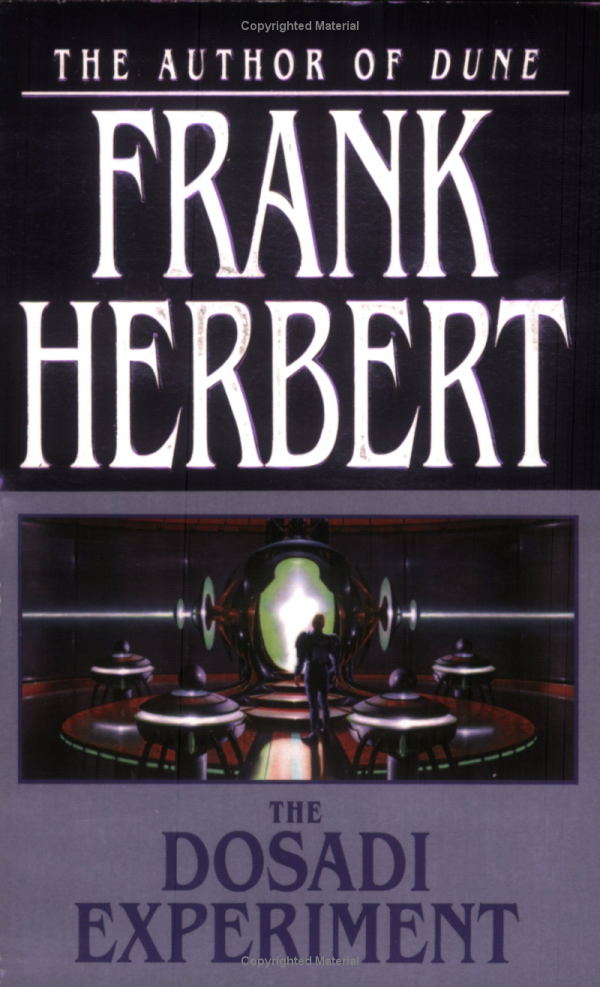
The Dosadi Experiment is a science fiction novel written by Frank Herbert in 1977. Jorj X. McKie is a saboteur extraordinary, one of the principles of BuSab, and the only human admitted to practice law before the Gowachin bar as a legum (lawyer). |
 |
Summary
The Gowachin are a species of frog-people (in human terms) that utilise a form of survival of the fittest right from their tadpoles to the very pinnacle of their society. Their legal practices are based upon the notion of a healthy disrespect for the law: the losing legum may be killed by the winning legum; a client pronounced innocent before the court is torn to pieces by angry spectators; judges may have bias ("if I can decide for my side, I will"), but not prejudice ("I will decide for my side, regardless"); any participant in the trial is subject to judgement, including the judges.
McKie is chosen as a legum for the Gowachin to solve a particular problem: generations ago, a secret, unauthorized experiment was carried out with the help of the Caleban, a species of unparalleled power from another dimension, whose visible manifestation in this universe is as stars, and who provide jump-doors to sentients that allow instantaneous travel between any two points in the universe. The Caleban isolated a planet, Dosadi, behind "The God Wall", and onto the planet were placed humans and gowachin with an unstable form of government, the demo-pol. The planet itself is massively poisonous except for a narrow valley, into which millions of humans and gowachin are crowded under terrible conditions.
The problem which McKie must solve is caused by the Dosadi's nearness to escaping the God Wall. The apparent purpose of the experiment was to subject sentients to the worst conditions possible for survival and see what behaviours and instincts were bred as a response. Now the Dosadis are terrifying creatures with heightened perceptions, intelligence, and drive to survive and prosper; if they were to be loosed upon the universe, they would quickly conquer it. McKie must find a way to prevent the God Wall from breaking, preserving the secret of Dosadi, or find a way to destroy the planet, erasing the original crime with one of greater magnitude.
The actual purpose of the experiment is to perfect ego transfer. The Caleban follow contracts without exception, and the contract with the Caleban enforcing the God Wall states that no Dosadi may leave the planet. Thus, the only way for the Dosadi to escape is in the bodies of outsiders sent by the Gowachin to investigate Dosadi by switching egos with them. By perfecting ego transfer, the power brokers behind the experiment give themselves a kind of immortality: As they near death, they switch egos with a young person, taking a new body and extending their ego lifespan through several generations, and theoretically forever.
Analysis
The major themes of this novel are repeated in different forms in
other of Herbert's novels.
This novel is interesting to compare with the Dune series, in which the Fremen are also a people who survive under terrible conditions, breeding pure survival behaviours that make them dangerous to the rest of the universe.
In Dune, the Fremen are a religious sect in retreat the colonizes the desert planet Arrakis, a horrible environment in which the harshest conditions breed the most brutal survival behaviours, creating a population dangerous to the universe at large should they escape with conquest in mind (as they do in the sequels).
Likewise, the creation of a hyper-stressful environment as an incubator for the invention of a technological breakthrough occurs in Herbert's book Destination: Void, in which a crew of clones is placed on a spaceship designed to fail, necessitating the invention of an artificial consciousness to continue the mission, with destruction as their only alternative.
Finally, the use of some form of ego transfer to grant immortality is revealed as a practice of the Bene Tleilaxu in Heretics of Dune. In the Dune universe, ego transfer occurs as a result of actual cloning, where the clones recover the memories of their ancestors by undergoing a carefully staged moment of great stress.
There are also interesting parallels between the society on Dosadi and that described by anthropologist Colin Turnbull in his book The Mountain People (written in 1972, 5 years before The Dosadi Experiment). That book describes an Ugandan tribe, the Ik, whose conditions are so desperate and impoverished that they also have learned to survive at whatever cost, up to and including the lives of their own families.
This novel is a sequel to Whipping Star.