
Search
Categories
Famous Authors
Top Selling Books
Book Home  Books Information Discworld
Discworld
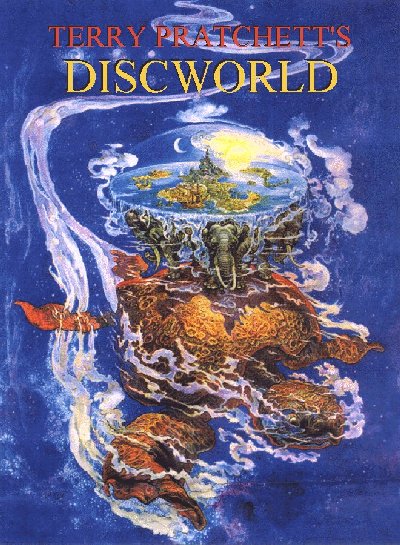
The Discworld is a series of over 30 novels by Terry Pratchett set on the Discworld. Since the first novel, The Colour of Magic (1983), the series has gone from strength to strength, spawning related works including music inspired by the series, as well as cartoon and theatre adaptations. Newly released Discworld books regularly top The Sunday Times bestsellers list, with Pratchett being the UK's best selling author in the 1990s, mainly on the strength of the Discworld (he has since been overtaken by Harry Potter author J.K. Rowling, but still holds the record for the most shoplifted books).
|
 |
Discworld novels have also won awards such as the Prometheus Award and the Carnegie Medal. In the BBC's Big Read, four Discworld books were in the top 100, and a total of fourteen in the top 200.
The novels
The world has been chronicled through at least 30 novels and several
short stories so far. The novels prior to The Truth (and almost all
Pratchett books to date) had cover art done by Josh Kirby (who died
in October 2001), but only in the original British editions. The American
editions, published by HarperCollins, do not feature Kirby's cover
art. Recent British editions of Pratchett's older novels no longer
feature Kirby's art. Since the death of Kirby, the covers have been
designed by artist Paul Kidby.
Almost all of the Discworld novels are notable for having no chapter divisions. Instead, most of the time there are different storylines interwoven with each other. Going Postal did entirely the opposite even going so far as to include a prologue and epilogue along with brief teasers of what was to come in each chapter. The first Discworld novel, The Colour of Magic, was divided into "books".
Many novels share the same lead characters and show their development over time. Some of the main characters of one book may also make a cameo appearance in another book where they are not the primary focus; for example Samuel Vimes appears briefly in Going Postal. The novels can be grouped into several story arcs, with characters or themes in common:
The Rincewind stories - These stories centre on a "wizzard" (the label on his hat) of sorts called Rincewind. The "of sorts" is because Rincewind is a complete failure at magic, but through a series of events is recognised as a wizard (for want of any other suitable term). In Sourcery he defeats a Sourcerer, which technically makes him at least an eighth level wizard; the fact that this is achieved with a half-brick as opposed to magical adeptness is beside the point. The other wizards at the Unseen University are sometimes seen in these stories.
The Witches stories - These stories centre on the witches of Lancre, particularly Granny Weatherwax, Nanny Ogg, Magrat Garlick, and later Agnes Nitt.
The Death stories - These stories centre on Death in his usual personification as a skeleton in black robes with a scythe. Death's companions are his granddaughter Susan, his butler Albert and the Death of Rats, the rat equivalent of the human Death. In later novels Susan takes centre stage, although Death is still a key player. Death is the only character to appear in every single novel.
The City Watch stories - These stories centre on Ankh-Morpork's equivalent of a police force, the City Watch. Samuel Vimes leads the city watch, and among his officers are Carrot Ironfoundersson, Angua, Fred Colon, Detritus and "Nobby" Nobbs.
The Tiffany Aching stories - These stories centre on the character of Tiffany Aching, a young girl who has the unusual allies of the Nac Mac Feegle. The stories are primarily written as children's books. They also tie in to the Witches stories, especially A Hat Full of Sky.
The Miscellaneous stories - where none of the above five applies, or the main characters from them only appear briefly, or at least not as the main characters of the story in question. The best examples of these are possibly Small Gods and Pyramids.