Search
Categories
Famous Authors
Top Selling Books

Book Home  Books Information Caves of Steel
Caves of Steel
|
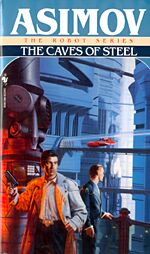
The Caves of Steel is a book by Isaac Asimov. It is essentially a detective story, and illustrates an idea Asimov advocated, that science fiction is a flavour that can be applied to any literary genre, rather than a limited genre itself. The book was first published as a serial in Galaxy Magazine, October to December 1953. A Doubleday hardcover followed in 1954.
Setting Asimov imagines the present day's underground transit connected to malls and apartment blocks, extended to a point where no one ever exits to the outside world. Indeed, most of the population cannot leave, as they suffer from extreme agoraphobia. In The Caves of Steel and its sequels, Asimov paints a grim situation of an Earth which has become pseudo-socialist to deal with an extremely large population, and of luxury-seeking Spacers who limit birth so that each may have great wealth and privacy. However, Asimov did not find the lack of daylight grim: one of his anecdotes tells how a reader asked him how he could have imagined such an existence with no sunlight. He relates that it had not struck him till then that living perpetually indoors might be construed as unpleasant. Plot summary One interesting aspect of the book is the contrast between Elijah, the human detective, and Daneel, the humanoid robot. Asimov uses the "mechanical" robot to inquire about human nature. When confronting a "Medievalist" who fears that robots will overcome humankind, Baley argues that robots are inherently deficient. Being precision-engineered calculating machines, they can have no appreciation of art, beauty, or God; robots can only understand concepts expressible in mathematics. However, in the concluding scene, R. Daneel exhibits a sense of morality. He argues that the captured murderer be treated leniently, telling his human companions that he now realizes the destruction of evil is less desirable than the conversion of evil into good. In the novel's final paragraphs, R. Daneel becomes a Christ figure. Baley does not react adversely to the disproof of his old contentions; in fact, he and Daneel exit the story walking arm-in-arm. |